

The Native Token of the Leondrino Ecosystem
The Native Token of the Leondrino Ecosystem
From the very beginning, XLEO was intended to shape the future of corporate finance and treasury management. Initially issued as a utility token within the Leondrino Ecosystem, XLEO is set to evolve over the medium term into an asset-backed token – strategically positioned to serve as a bridge and reserve currency in the growing world of enterprise-driven digital economies over the long term.
Be among the first to discover XLEO’s potential, now!
Take action before institutional investors begin building reserves in suitable digital assets.
To get all the details on available purchase options, please click here !!!
For further information on the XLEO Token, please read the XLEO whitepaper.
Role of XLEO
The Leondrino Ecosystem needs a stable bridge and reserve currency to enable a capital-efficient model of fractional reserve banking for corporate currencies. Moreover, it supports fast and fair transactions between different digital enterprise currencies.
Short-term Role
Utility Token for Leondrino Germany
- Accepted means of payment for services from Leondrino Germany (Leondra GmbH)
- Early and cheaper access to enterprise currencies
Long-term Role
Asset-referenced Currency
- Managed by the Leondrino Foundation
- Investment of reserves in other currencies, bonds and other investments
- “Supply Management Reserve” per enterprise currency is created via XLEO if the holding period is longer
Whitepaper
The XLEO Whitepaper gives you an overview of the Leondrino Ecosystem and its native token, the XLEO, and serves as a project description.
Please read through the XLEO Whitepaper and particularly the legal notices including the risk warning at the end of this document carefully before you decide on the purchase of XLEO tokens.
←
To read the XLEO Whitepaper, please click on the opposite picture.
Whitepaper
The XLEO Whitepaper gives you an overview of the Leondrino Ecosystem and its native token, the XLEO, and serves as a project description.
Please read through the XLEO Whitepaper and particularly the legal notices including the risk warning at the end of this document carefully before you decide on the purchase of XLEO tokens.
↑
To read the XLEO Whitepaper, please click on the opposite picture.
How to Invest
as Consumer / Retail Investor
Open a Leondrino Wallet, select the XLEO token and add it to your wallet. Follow the instructions to buy the XLEO token in the Leondrino Wallet.
Please note that the number of tokens that you can purchase via the Leondrino Wallet is limited depending on your user classification and the Leondrino Token Class in which the token is located.
Quick Guide:
- Open a Leondrino Wallet
- Maintain your user profile
- Identify yourself (Leondrino KYC Check)
- Add the XLEO to your wallet
- Click on BUY TOKEN
- Read and accept the Token Sale Terms
- Enter the desired amount and pay in Euro
- Receive XLEO credit note
- Done!
as Professional Investor
If you are a private investor or a wealth manager of a Family Office, VC or Token Fund, who intends to invest larger amounts, please approach us directly using our email address investor@leondrino.de.
You will receive information material and a contract proposal for a purchase agreement (SAFT – simple agreement on future token) and/or a contract proposal to sign a loan with the option to convert into token after they are available for public trade (also called Leondrino Convertible).
An attractive discount is offered depending on the size and date of your commitment.
Quick Guide:
- Contact Leondrino with “XLEO Token” as subject and specify the desired investment amount
- Conclude a Leondrino SAFT contract or a Leondrino Convertible
- Transfer the investment amount due
- Open a Leondrino Wallet
- Receive XLEO credit note
- Done!
Leondrino Wallet
Open your multi-currency wallet to access brand-specific benefits at checkout and to take advantage of enterprise currencies.
Build up a portfolio with enterprise currencies, manage it in your Leondrino Wallet on your own device and benefit from paying with branded Leondrino Currencies.

Who we are and What we are up to
Our vision is to enhance the stability and fairness of the financial system, making it accessible to everyone. We aim to achieve this by complementing it with competing digital currencies issued by corporations and corporate networks.
These currencies usually start as utility tokens and evolve into extended utility tokens or regulated stablecoins. Leondrino provides a pathway for corporations to issue their branded corporate currencies – in Europe under MICA regulation. In the U.S., a relevant regulatory framework is evolving (GENIUS Act, Clarity Act).

The German licensee of Leondrino based in Berlin (Leondra GmbH) is one of the pioneers in the field of cryptocurrencies and offers its customers an innovative and unique ‘Currency Management-as-a-Service’; corporate customers can issue their own branded digital currencies and make them tradable.
Learn more about the milestones achieved, the Leondrino Standard and about our team.

Newsletter
Stay informed about Leondrino’s progress and when new branded Leondrino Currencies are available by subscribing to our newsletter.
FAQ
General
One major building block for realizing the Leondrino Vision is the Leondrino Ecosystem’s native currency — the XLEO. This token is designed to become a bridge and reserve currency in the long term.
Please read the XLEO Whitepaper to find all the information about the XLEO token and its role in the Leondrino Ecosystem.
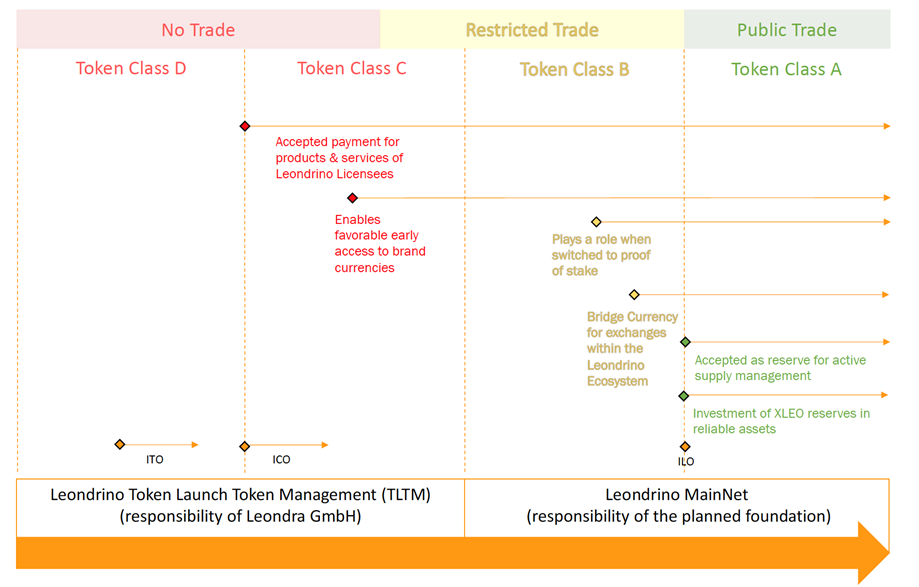
The intended ultimate role of XLEO in its highest stage of development (Token Class A) differs fundamentally from other Leondrino corporate currencies: in this target state, XLEO serves as a fully backed reserve currency and a stable bridge between the various branded corporate currencies in Token Class A.
The long-term interplay between XLEO and corporate currencies builds trust, strengthens stability, and enables the scalability of the entire Leondrino ecosystem.
The document „Leondrino Monetary Architecture“ describes this unique role of XLEO within the ecosystem in detail and outlines how it differs from other corporate currencies of Leondrino Token Class A.
With the fading trust in public treasuries, gold is regaining its significance as an investment alternative. At the same time, technological innovations are receiving increased attention. In particular, the development of stablecoins has the potential to fundamentally reshape the landscape of global finance.
Currently, stablecoins of the first generation are the primary focus. These are primarily characterized by their fixed peg to a national currency, with leading stablecoin providers typically ensuring a full reserve (100%) in the form of government bonds and cash. The US dollar currently plays a dominant role in this regard.
Leondrino of the highest quality (Leondrino Token Class A) are often considered by analysts as the logical next step in the evolution of stablecoins. But what distinguishes stablecoins of the next generation?
Definition of Second-Generation Stablecoins:
- In contrast to first-generation stablecoins, the stability of second-generation stablecoins is not based on a fixed peg to a national currency, but rather on the utility value of products and services within the issuer’s ecosystem.
- Second-generation stablecoins are distinguished by an acceptance obligation from the issuer, which is often extended to additional partners within the ecosystem as well as to external acceptance points.
- For each issuer, a unique monetary policy is defined, with governance either decentralized or monitored by an independent entity – as is the case with Leondrino. This structure also governs the management of the money supply.
- A fractional reserve system is implemented, taking into account the specific situation of each issuer and supported by a bridge and reserve currency. This enables efficient capital deployment while ensuring adequate liquidity.
- It is expected that large issuers of second-generation stablecoins will increasingly pursue and implement greater flexibility in the allocation of their reserves. In the case of Leondrino, the bridge and reserve currency XLEO will play a central role in the medium term, as it will manage the reserves of the highest category of corporate currencies (Leondrino Token Class A). Through increased flexibility in reserve allocation (Total Value Locked), a reduction in the dependency of these stablecoins on individual national currencies is achievable in the long term.
Second-generation stablecoins – particularly those issued by established corporations and growth companies following the Leondrino standard – provide a resilient approach to value storage and cross-border payments, complementing and operating independently of traditional fiat currency systems. Their integration into mass-market infrastructure can sustainably enhance the resilience of digital economic ecosystems at both regional and global scales.
XLEO currently serves as the primary utility token of the entire Leondrino platform. It provides access to the Leondrino Platform and its services within the Leondrino Ecosystem and supports the establishment of the technological, legal, and commercial infrastructure required for future branded corporate currencies. In the long term, its role is designated to be the bridge and reserve currency for the entire Leondrino network.
XLEOPRE, on the other hand, was created as a limited high-risk pool parallel to the existing XLEO of Leondrino Token Class C to enable an early listing, aligned with the expectations of modern alternative investment and token funds. Implemented based on the ERC-20 standard, XLEOPRE supports the early development of a professional investor community and market validation. It allows for early, limited participation via a public blockchain in the holistic XLEO concept and fosters market-based price discovery through secondary market trading.
For more details – see the XLEOPRE Project
Regulatory Classification and Future Evolution of XLEO
XLEO has been deliberately designed to follow the progressive development of both the Leondrino ecosystem and the evolving regulatory framework.
At its current stage, XLEO primarily serves as the core utility token of the Leondrino platform. It provides access to the platform’s products and services within the ecosystem and supports the establishment of the technological, legal, and commercial infrastructure required for branded corporate currencies.
This reflects the token’s current economic function rather than its final role within the Leondrino ecosystem.
Potentially, yes.
Leondrino has developed a token class model that allows digital currencies to evolve alongside their economic purpose and regulatory environment.
Rather than assuming a single legal classification will remain appropriate throughout the entire lifecycle of a digital currency, Leondrino distinguishes among several token classes with increasing regulatory requirements and economic functionality.
This modular approach enables an orderly migration to higher regulatory standards when market adoption, reserve mechanisms, or applicable regulations make such a transition appropriate.
The global regulatory framework for digital currencies is evolving rapidly.
Europe has introduced the Markets in Crypto Assets Regulation (MiCAR), while jurisdictions such as the United States are establishing new legal frameworks for payment stablecoins and digital assets. Additional regulatory developments are anticipated over the coming years.
Branded corporate currencies are likely to evolve over long horizons. A token architecture must therefore be capable of adapting to future regulation without requiring enterprises to redesign their entire digital currency infrastructure.
The Leondrino token class model was designed with exactly this objective in mind.
Not necessarily in the legal sense of how a stablecoin is currently defined by Europe’s Markets in Crypto-Assets Regulation (MiCAR).
The long-term role of XLEO is to serve as the bridge and reserve currency of the emerging Leondrino ecosystem for enterprise currencies. The precise regulatory classification of this future role will depend on several factors, including:
- the future evolution of European regulation,
- developments in other major jurisdictions,
- the economic function of XLEO, and
- the final reserve and redemption architecture adopted at maturity.
Leondrino therefore intentionally avoids locking the project into a regulatory category that may itself evolve over time.
Based on the current MiCAR framework, the Asset-Referenced Token (ART) regime appears to be the most suitable direction for XLEO’s long-term role. However, Leondrino believes that the ART framework could benefit from further refinement to better accommodate emerging bridge and reserve currency models for corporate ecosystems. The ongoing MiCAR review may provide an opportunity for such developments.
If regulatory developments or business requirements justify a higher regulatory classification, Leondrino may migrate an existing token into a higher token class.
Such a migration would be performed under predefined rules and with full transparency toward token holders.
From an economic perspective, the objective is continuity rather than replacement. A token transitioning to a higher Leondrino token class continues to represent the same branded ecosystem or corporate network while complying with the regulatory framework appropriate to its increased level of maturity and expanded functionality.
The initial issuance phase has a fundamentally different economic purpose than the mature reserve phase.
During the early development of the ecosystem, capital is required to finance:
- technology development,
- regulatory approvals,
- ecosystem expansion,
- strategic partnerships, and
- market adoption.
Once the ecosystem has reached sufficient scale, XLEO is intended to transition toward its long-term role as the reserve layer for branded corporate currencies. Accordingly, the reserve policy is expected to evolve over time.
The long-term objective remains a reserve structure consistent with the investment policy described in the XLEO Whitepaper.
Leondrino believes that digital currencies should evolve similarly to successful technology platforms. A company does not build its final infrastructure on day one; it develops it in successive stages. The same principle applies to branded corporate currencies.
The legal framework should enable innovation during the early stages while allowing an orderly transition toward increasingly regulated forms of digital money as systemic relevance and market adoption increase. Leondrino’s token class model has been designed precisely to support this evolution.
The ongoing review of Europe’s Markets in Crypto-Assets Regulation (MiCAR*), alongside US legislative initiatives like the Guiding and Establishing National Innovation for U.S. Stablecoins Act (GENIUS Act**) and the Digital Asset Market Clarity Act (Clarity Act***), as well as initiatives in other relevant legal spheres, provide an opportunity to introduce a more explicit regulatory migration path for digital currencies.
Between today’s utility tokens and fully regulated stablecoins, a growing class of global enterprise ecosystem currencies is emerging. These currencies gradually increase their economic relevance, reserve mechanisms, and payment functionality over time. A future-proof regulatory framework should recognize this natural evolution instead of forcing projects into a binary choice between utility tokens and fully regulated stablecoins at a very early stage.
______
* MiCAR: European Regulation on Markets in Crypto-Assets; establishes a unified legal framework for crypto-assets, issuers, and service providers in the EU. MiCAR is currently undergoing review to refine token classifications (currently: asset-referenced tokens, e-money tokens, and utility tokens) toward a more market-reflective approach and adapt regulation accordingly.
** GENIUS Act: US legislative framework for stablecoin issuers; establishes eligibility standards, reserve and asset-backing requirements, transparency, and consumer protections.
*** Clarity Act: US legislative initiative for digital asset markets; provides a clear regulatory path for digital assets, oversight of intermediaries, and consumer safeguards alongside innovation.
XLEOPRE – The First Tradable Pool
for Token and Alternative Investment Funds
XLEOPRE was created as a limited high-risk pool in parallel to the existing XLEO of Leondrino token class C to enable an early listing in line with the expectations of modern alternative investment and token funds. XLEOPRE was implemented based on ERC-20 standard and supports the early development of a professional investor community and market validation by enabling early, limited involvement via public blockchain in the holistic XLEO concept and facilitating market-based price discovery via secondary market trading.
For more details – see the XLEOPRE Project